

One way to navigate rapid, deep change is by focusing on things that are "real" or tried-and-true. We're on the edge today of AI being able to make up any audio, still image, video, or any answer to any question. What is the ground truth? Is there one?
Without getting too philosophical (which would be fun, I have to admit), here are some tips and short stories of things I've found useful to remember when dealing with these new technologies.
LLM randomness
When writing software, coming up with random numbers can be difficult. There are levels to the randomness and getting a truly random number is close to impossible. The good news is that most of the time you don't care about truly random numbers and the approximations the computer gives you are varying degrees of "random." Put another way, as a developer you can choose how seriously random you want a number to be. Up to a point. Most of the time you can use one of the available methods of choosing a random number at it'll work just fine for you.
The other day I asked ChatGPT to give me a random number between 1 and 100. Before I tell you what it gave me, try it out for yourself. Go to ChatGPT and ask it to give you a random number between 1 and 100. My guess is it'll give you 47. If you want to try Gemini or Claude that's fine, too. I predict they'll give you 47 as well. Why did ChatGPT give me 47 and why do I predict it'll give you 47? It's not because ChatGPT uses any of the methods software developers have available to them to get a random number. Because LLMs don't use any of those traditional methods to give a response to "give me a random number from 1 to 100." The LLMs do what they do with all questions. They do a word prediction for what's the likely next word. Or more generally, they do a prediction of what is the most likely word-answer to this question based on their training data. It seems that according to the text that ChatGPT is trained on, 47 is the most common human response when humans write down the answer to "What's a random number from 1 to 100?" If you ask ChatGPT 10,000 times to give you a random number from 1-100, here's what the distribution of responses looks like:
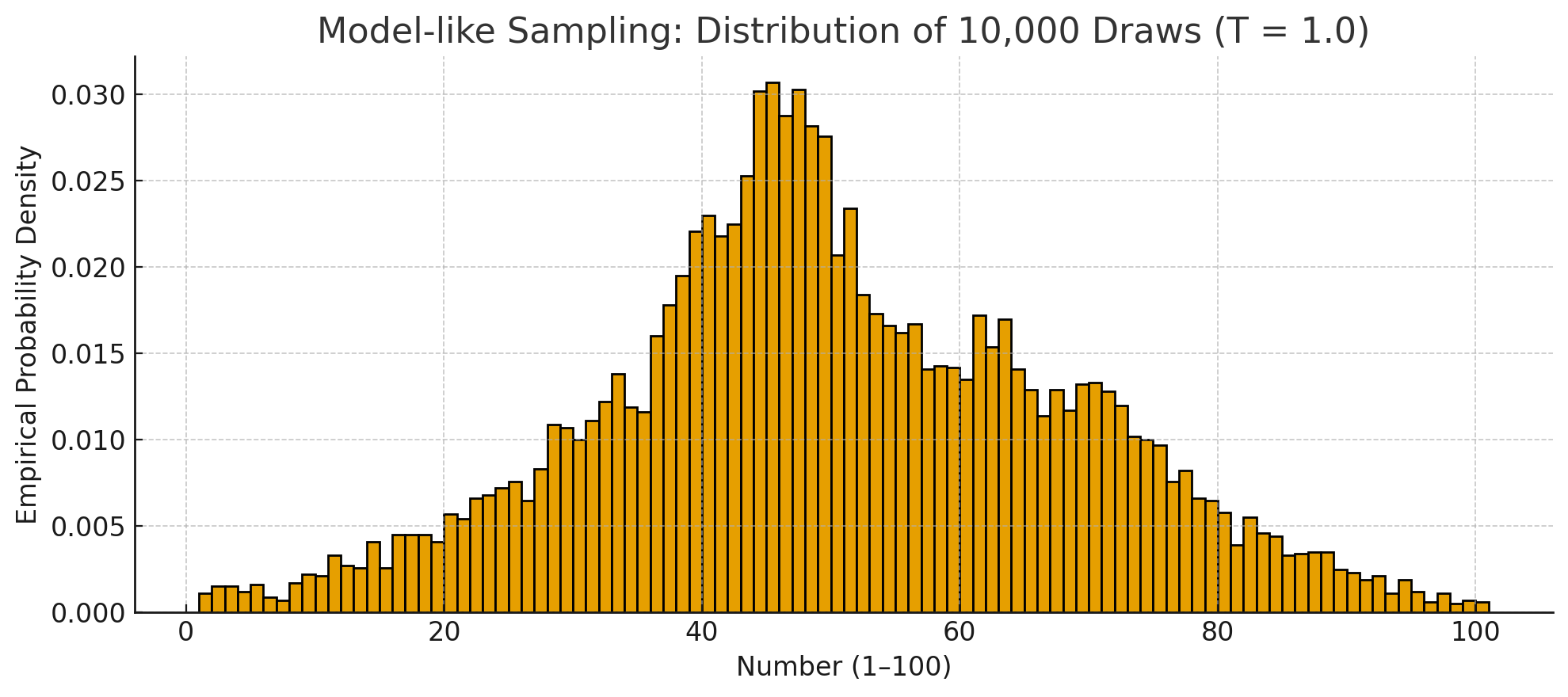
If the responses were random, we'd expect that chart to roughly flat, that there's an equal chance for each number to be chosen at random. But of course there isn't an equal number of mentions of each number 1 to 100 in ChatGPT's training data for the answer to the question. As you can see, the most common answers in the training data seems to be centered around the high 40's.
So why doesn't ChatGPT give the number 47 every time I ask for a new random number? Temperature. In the chart, it shows a temperature of 1.0 That means it's responing with a mix of most common answer with a little variance thrown in to provide more "creative" or "interesting" answers. You can choose to drop the temperature to decrease the variance (for example, responses limited to the 40's) or you could raise the temperature and ChatGPT would more likely respond with a wider range of numbers to the "random" question.
Why mention all this? I think it's a good example of how as humans we might expect an evenly distributed random answer from an LLM when we ask it to give us a random number from 1 to 100. But because of the way the way LLMs work and their training data, the answer is far from random. Of course the LLM will be quite confident in giving you 47! So there's a pretty big conceptual mismatch between what we think we're getting and what we're getting. This isn't a hallucination; this is the LLM accurately doing its job. It's not evaluating the definition of the word "random." It's just looking for the words "random", "1", "100", etc. in close proximity in its training data.
Update: This morning, 19 November 2025, Google released Gemini 3. And it appears to give a much more random response to the question! I asked it to give me 10,000 random numbers between 1 and 100 and here's the distribution:
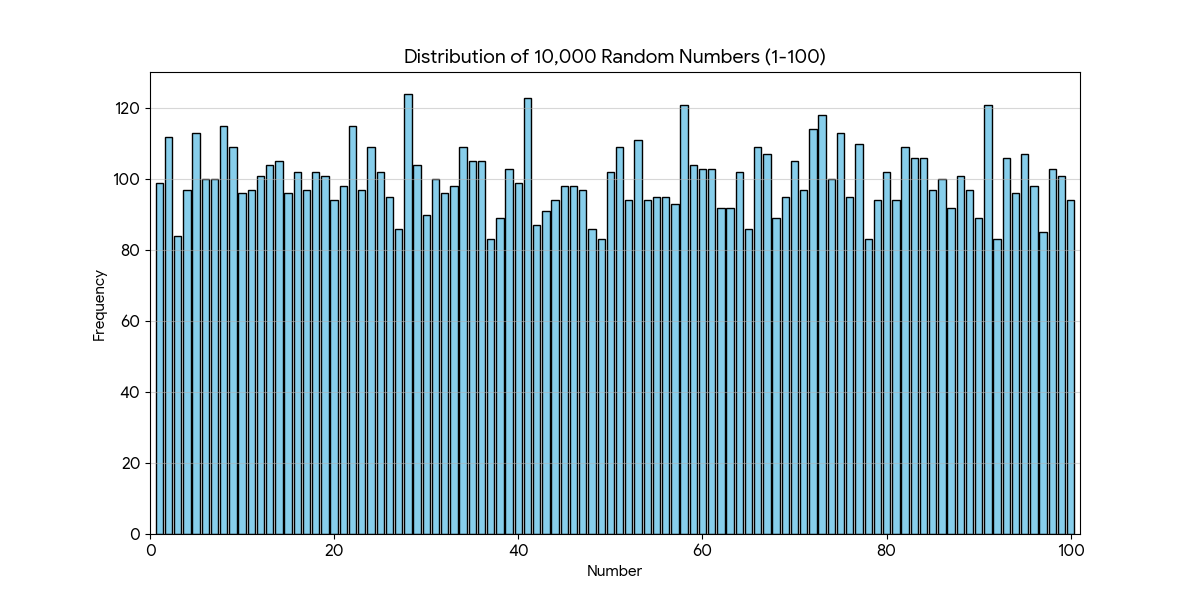
So, Google is somehow imbuing more smarts into their queries than just looking up words in the training data as I described above for ChatGPT. What a time to be alive!
Only getting worse
Right now, we may be in a Golden Age for LLMs. From here on out, they're only going to get more expensive to use. The OpenAIs and Googles of the world can't keep absorbing the massive costs of the LLMs forever. And apart from cost, the LLMs are running out (have already run out?) of new data to train on. Some people believe that creating synthetic training data is a good approach to this issue and thus we'll never run out of new data. I don't think that's a good idea. It's hard for me to imagine the data quality of synthetic data is good enough for additional training of LLMs in any positively meaningful way. And just like a dog chasing its tail, when LLMs train on user conversations, eventually that's a race to the bottom where only the most popular responses bubble up to the top.
Hopefully there will be a step change in LLM technology (maybe like what Google just released in Gemini 3?) or perhaps even something radically different that provides similar results such that the machine doesn't have to keep growing and eating the internet to be useful.
On the other hand...
Because LLMs are the great equalizers they give access to "expert" knowledge to everyone who can use a web-connected device. The health information alone that is now accessible to billions of people is a game changer that we don't fully understand yet. Even here in Wellington at my local GP's office, when you make an appointment to see a doctor the receptionist asks if it's ok with you if the doctor uses AI. Two years ago I spoke with several doctors and nurses at Wellington Hospital and they were quite nervous about LLMs taking their jobs. Maybe they still are, but it does sound like at least part of the medical community is embracing these tools and using them to augment what they can offer to patients.
When search engines in general, and Google in particular, came on the scene lots of people worried about the public getting wrong information from the web. And they still worry because there's still a lot of wrong info on the web! The point is, society learns how to deal with these new technologies. Some people will never be convinced that new things are good but most people will figure it out and use new tech in ways that helps them.
What's real for New Zealand?
In the end, what's real will be driven by the youth of today. In my opinion, we need to educate them much better on the usage and creation of AI. I (and a few others) wrote a white paper about this topic if you're interested: https://bemorehuman.org/s/Unleashing_NZ_13.pdf
As always, feedback is welcomed!